



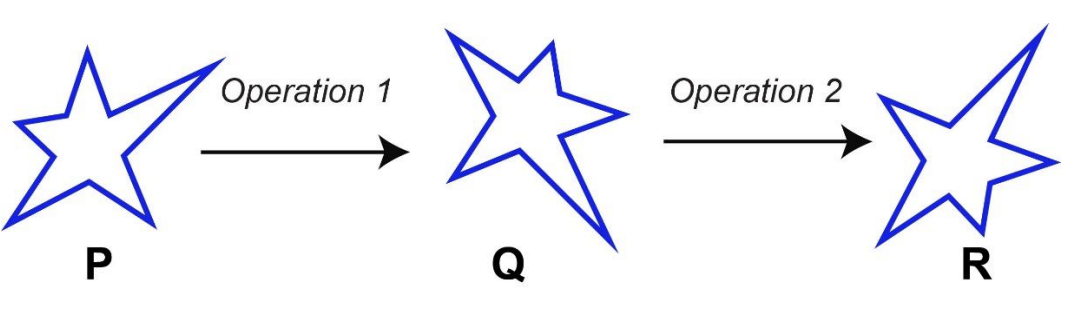
Which one of the options best describes the transformation of the -dimensional figure to , and then to , as shown?
View worked solution
Answer: A
To determine the correct transformations, let us analyze the changes in orientation from figure to , and then from to :
-
Step 1: Transformation from to (Operation 1)
- Observe the orientation of the main features in . The long straight edge of the figure is initially vertical.
- In figure , this long edge has become horizontal, and the protruding elements have rotated to point downwards.
- This corresponds to a clockwise rotation by about an axis perpendicular to the plane of the figure.
- This eliminates options B and D.
-
Step 2: Transformation from to (Operation 2)
- Comparing and , we see that the left-to-right orientation of the features remains identical.
- However, the top-to-bottom orientation is inverted (the parts pointing downwards in are pointing upwards in ).
- An inversion along the vertical axis (top-to-bottom flip) is achieved by a reflection along a horizontal line.
- A reflection along a vertical line would have flipped the left and right sides, which is not the case here. This eliminates option C.
Thus, the correct sequence of operations is a clockwise rotation by followed by a reflection along a horizontal line.
Free practice · Your answers on this page are not saved.