



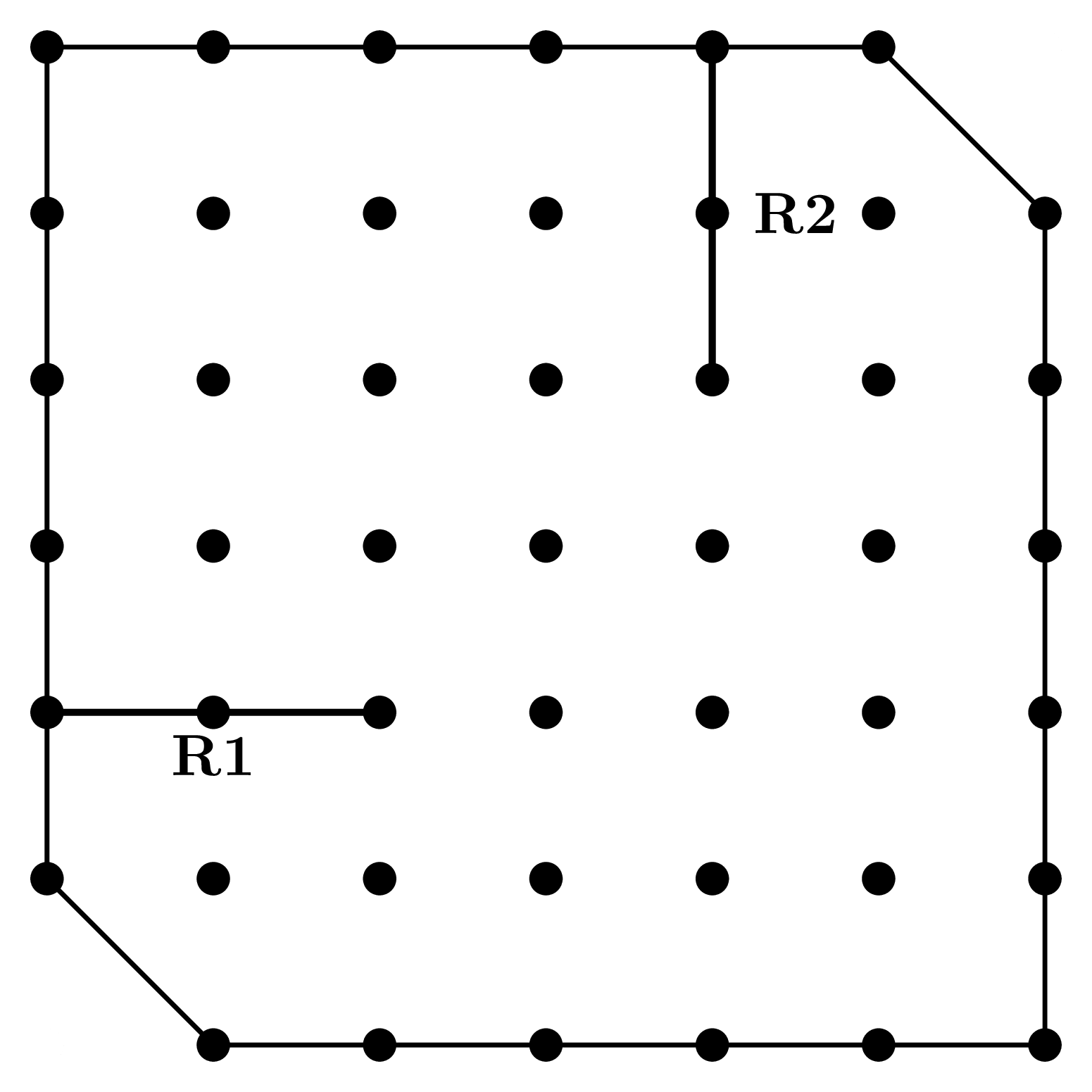
A plot of land must be divided between four families. They want their individual plots to be similar in shape, not necessarily equal in area. The land has equally spaced poles, marked as dots in the below figure. Two ropes, and are already present and cannot be moved.
What is the least number of straight ropes needed to create the desired plots? A single rope can pass through three poles that are aligned in a straight line.
View worked solution
Answer: D
The plot of land is represented by a grid of poles forming a square. Two perpendicular ropes, (horizontal from the left edge to the center) and (vertical from the center to the top edge), are already fixed.
To divide the square plot into four geometrically similar shapes (specifically, right-angled triangles of different sizes), we can add 3 additional straight ropes as follows:
- Rope 3 (Diagonal): A straight diagonal rope from the bottom-left corner to the top-right corner, passing through the center pole.
- Rope 4 (Vertical): A vertical rope from the bottom-middle pole to the top-middle pole (overlapping with ).
- Rope 5 (Horizontal): A horizontal rope from the left-middle pole to the right-middle pole (overlapping with ).
This partition successfully divides the land into four similar right-angled triangles. Thus, the minimum number of additional straight ropes required is 3.
Free practice · Your answers on this page are not saved.