



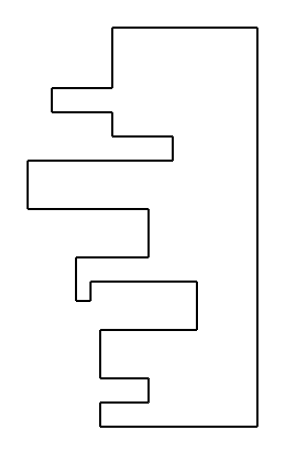
A jigsaw puzzle has pieces. One of the pieces is shown above. Which one of the given options for the missing piece when assembled will form a rectangle? The piece can be moved, rotated or flipped to assemble with the above piece.
View worked solution
Answer: A
To form a perfect rectangle, the missing piece must have three straight outer edges and one irregular inner edge that is the exact complement (mirror-fit) of the irregular right edge of the given piece.
Let us analyze the irregular right edge of the given piece from top to bottom:
- A prominent protrusion (tab) near the top.
- A deep rectangular indentation (recess) in the middle.
- A smaller protrusion near the bottom.
The complementary piece must therefore feature:
- A corresponding indentation at the top to receive the top protrusion.
- A matching protrusion in the middle to fill the middle indentation.
- A corresponding indentation near the bottom to receive the bottom protrusion.
By rotating and flipping the piece in Option A, its profile perfectly aligns and interlocks with the given piece to form a complete rectangle without any gaps or overlaps.
Free practice · Your answers on this page are not saved.