

Skip to content
Official PYQ · 2003

GATE CS 2003 Q47 — Combinational Circuits

Explain with AI

Consider the following circuit composed of XOR gates and non-inverting buffers.
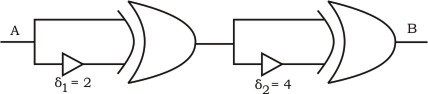
The non-inverting buffers have delays δ1=2ns\delta_1 = 2 ns and δ2=4ns\delta_2 = 4 ns as shown in the figure. Both XOR gates and all wires have zero delays. Assume that all gate inputs, outputs, and wires are stable at logic level 00 at time 00. If the following waveform is applied at input AA, how many transition(s) (change of logic levels) occur(s) at BB during the interval from 00 to 1010 ns?

Choose one option
View worked solution

Answer: D

Let A(t)A(t) be the input signal. The circuit consists of two cascaded stages of XOR gates with delayed feedback paths:

  • The output of the first XOR gate is:
    X(t)=A(t)⊕A(t−2)X(t) = A(t) \oplus A(t - 2)
  • The output of the second XOR gate (the final output BB) is:
    B(t)=X(t)⊕X(t−4)B(t) = X(t) \oplus X(t - 4)

The input waveform A(t)A(t) has a single transition from 00 to 11 at t=1 nst = 1\text{ ns}:

A(t)={0,t<1 ns1,t≥1 nsA(t) = \begin{cases} 0, & t < 1\text{ ns} \\ 1, & t \ge 1\text{ ns} \end{cases}

We can now determine the intermediate signal X(t)X(t):

  • For t<1 nst < 1\text{ ns}: A(t)=0A(t) = 0 and A(t−2)=0  ⟹  X(t)=0⊕0=0A(t-2) = 0 \implies X(t) = 0 \oplus 0 = 0
  • For 1 ns≤t<3 ns1\text{ ns} \le t < 3\text{ ns}: A(t)=1A(t) = 1 and A(t−2)=0  ⟹  X(t)=1⊕0=1A(t-2) = 0 \implies X(t) = 1 \oplus 0 = 1
  • For t≥3 nst \ge 3\text{ ns}: A(t)=1A(t) = 1 and A(t−2)=1  ⟹  X(t)=1⊕1=0A(t-2) = 1 \implies X(t) = 1 \oplus 1 = 0

Thus, X(t)X(t) is a pulse of duration 2 ns2\text{ ns} active during the interval [1,3] ns[1, 3]\text{ ns}.

Next, we find B(t)=X(t)⊕X(t−4)B(t) = X(t) \oplus X(t-4):

  • X(t)X(t) is active (11) during [1,3] ns[1, 3]\text{ ns}.
  • X(t−4)X(t-4) is active (11) during [5,7] ns[5, 7]\text{ ns}.

Since these two intervals do not overlap, the XOR output B(t)B(t) is active during both intervals:

B(t)=1for t∈[1,3] ns and t∈[5,7] nsB(t) = 1 \quad \text{for } t \in [1, 3]\text{ ns} \text{ and } t \in [5, 7]\text{ ns}

The transitions at BB occur at t=1 nst = 1\text{ ns}, t=3 nst = 3\text{ ns}, t=5 nst = 5\text{ ns}, and t=7 nst = 7\text{ ns}. This results in exactly 4 transitions during the interval from 00 to 10 ns10\text{ ns}.

Free practice · Your answers on this page are not saved.

Published
Report a correction
Keep exploringMore Combinational Circuits questions
