Skip to content
Official PYQ · 2024

GATE CS 2024 Set 1 Q54 — Combinational Circuits

Explain with AI

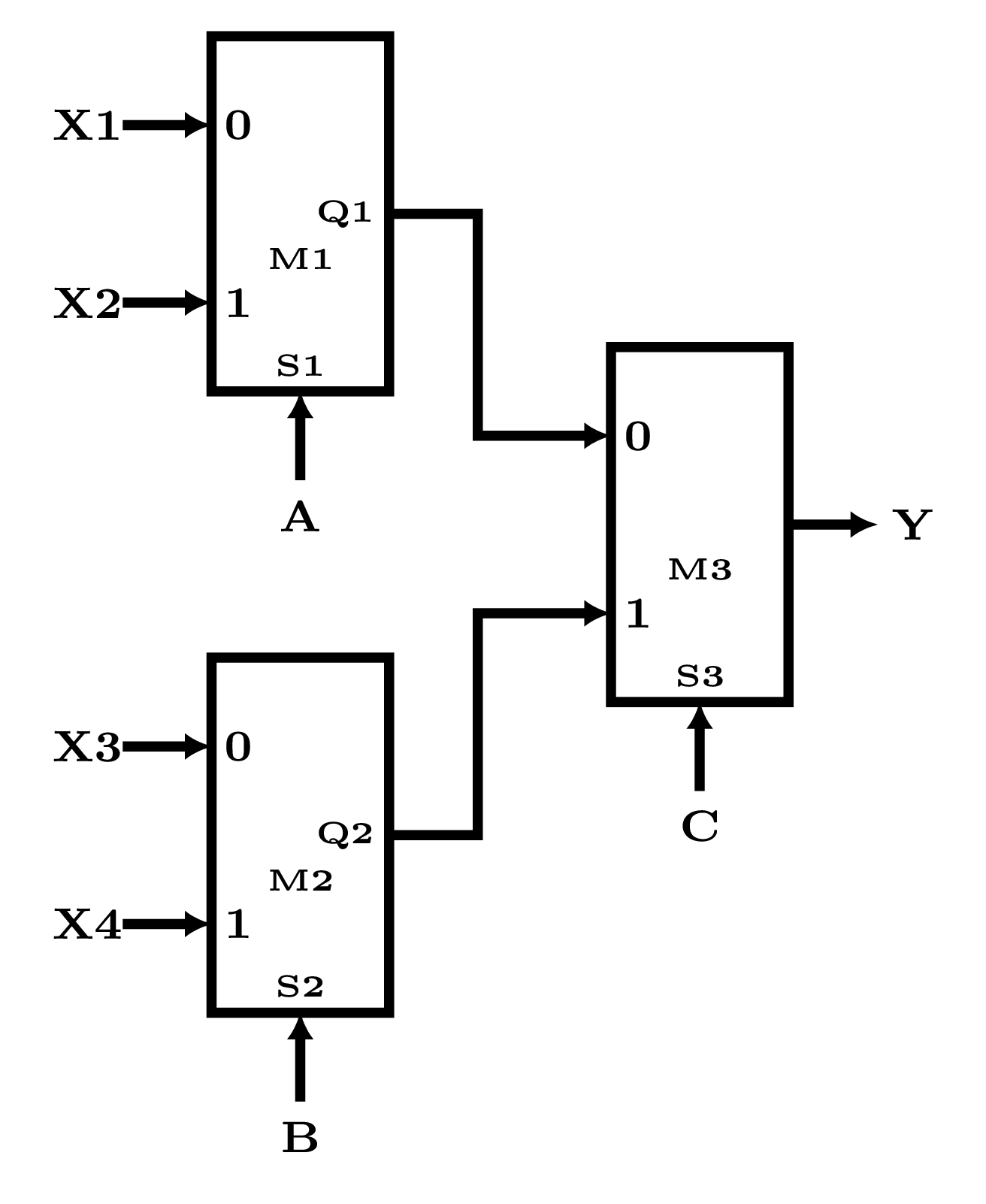
Consider a digital logic circuit consisting of three 22-to-11 multiplexers M1, M2\text{M1, M2}, and M3\text{M3} as shown below. X1\mathrm{X} 1 and X2\mathrm{X} 2 are inputs of M1\mathrm{M} 1. X3\text{X3} and X4\text{X4} are inputs of M2\text{M2}. A, B\text{A, B}, and C\text{C} are select lines of M1, M2\text{M1, M2}, and M3\text{M3}, respectively.

For an instance of inputs X1=1,X2=1,X3=0\mathbf{X} \mathbf{1}=\mathbf{1}, \mathbf{X} \mathbf{2}=\mathbf{1}, \mathbf{X} \mathbf{3}=\mathbf{0}, and X4=0\mathbf{X} \mathbf{4}=\mathbf{0}, the number of combinations of A,B,C\mathrm{A}, \mathrm{B}, \mathrm{C} that give the output Y=1\mathbf{Y}=\mathbf{1} is ____________.

View worked solution

Answer: 4

Let the outputs of the multiplexers M1M_1 and M2M_2 be Y1Y_1 and Y2Y_2, respectively. For a standard 22-to-11 multiplexer with select line SS and inputs I0I_0 (at select 00) and I1I_1 (at select 11), the output is given by Y=SˉI0+SI1Y = \bar{S}I_0 + SI_1.

Given the input values:

  • X1=1X_1 = 1 and X2=1  ⟹  Y1=Aˉ(1)+A(1)=1X_2 = 1 \implies Y_1 = \bar{A}(1) + A(1) = 1 (independent of AA)
  • X3=0X_3 = 0 and X4=0  ⟹  Y2=Bˉ(0)+B(0)=0X_4 = 0 \implies Y_2 = \bar{B}(0) + B(0) = 0 (independent of BB)

The multiplexer M3M_3 takes Y1Y_1 and Y2Y_2 as its inputs, with CC as the select line. Its output YY is:

Y=CˉY1+CY2Y = \bar{C}Y_1 + CY_2

Substituting Y1=1Y_1 = 1 and Y2=0Y_2 = 0 into the equation:

Y=Cˉ(1)+C(0)=CˉY = \bar{C}(1) + C(0) = \bar{C}

For the final output to be Y=1Y = 1, we must have:

Cˉ=1  ⟹  C=0\bar{C} = 1 \implies C = 0

Since the output YY depends only on CC, the select lines AA and BB can take any binary value. Thus, the valid combinations of (A,B,C)(A, B, C) are:

{(0,0,0),(0,1,0),(1,0,0),(1,1,0)}\{ (0, 0, 0), (0, 1, 0), (1, 0, 0), (1, 1, 0) \}

Therefore, there are exactly 4 combinations of A,B,CA, B, C that yield Y=1Y = 1.

Free practice · Your answers on this page are not saved.

Published
Report a correction
Keep exploringMore Combinational Circuits questions