



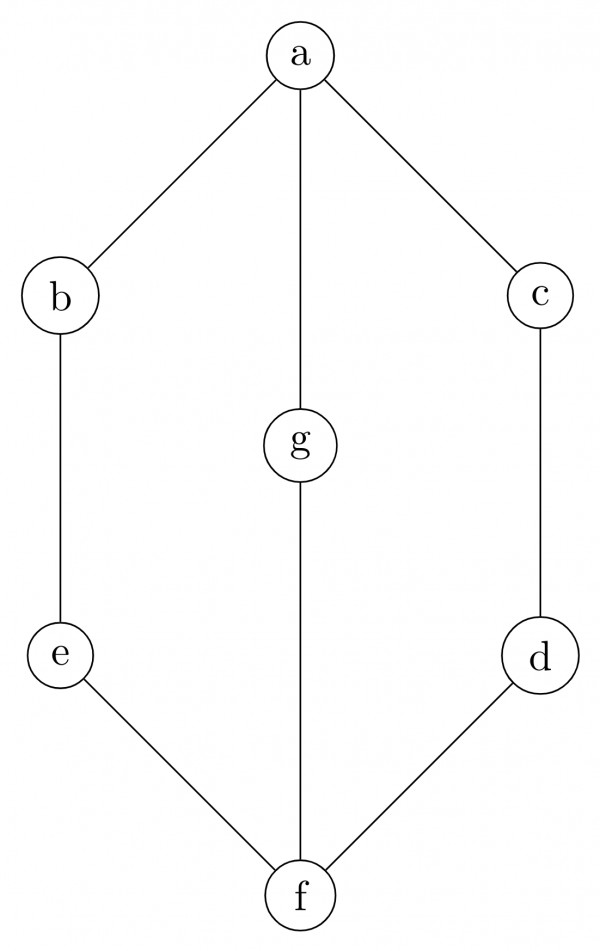
In the lattice defined by the Hasse diagram given in following figure, how many complements does the element ‘’ have?
View worked solution
Answer: B
In any lattice with a greatest element and a least element , an element is a complement of if and only if:
From the given Hasse diagram:
- The least element (bottom) of the lattice is .
- The greatest element (top) of the lattice is .
To find the complements of , we look for elements such that and :
- For : and
- For : and
- For : and
Thus, the element has exactly three complements: , , and .
Free practice · Your answers on this page are not saved.