



Consider the set under partial ordering
The Hasse diagram of the partial order is shown below.
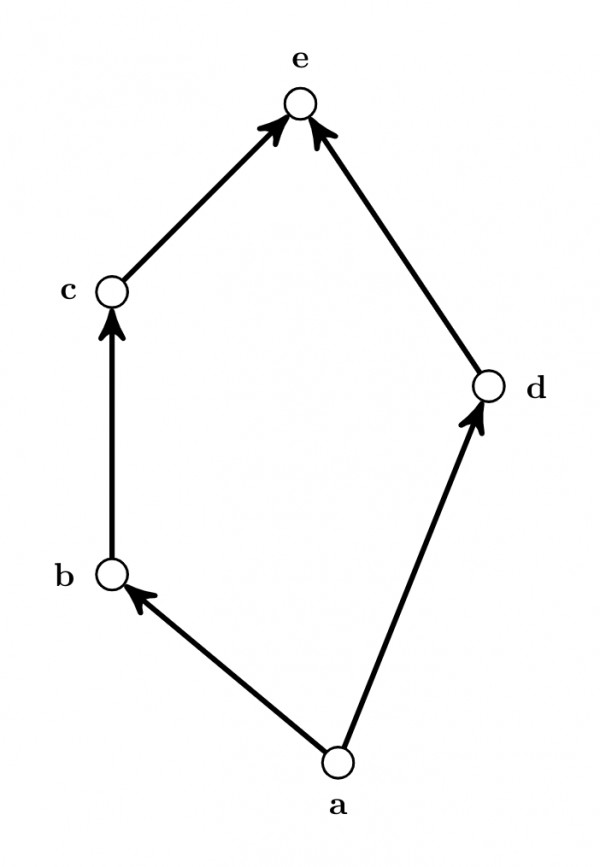
The minimum number of ordered pairs that need to be added to to make a lattice is ______
View worked solution
Answer: 0
A partially ordered set (poset) is a lattice if every pair of elements has a unique least upper bound (LUB, join) and a unique greatest lower bound (GLB, meet).
From the given relation , we can trace the Hasse diagram:
- is the least element (since for all ).
- is the greatest element (since for all ).
- The elements form two main branches: and .
Let us verify the existence of LUB and GLB for all pairs of elements:
- For any pair containing the least element or the greatest element , the GLB and LUB trivially exist.
- For the pair : since , we have and .
- For the pair : the only common lower bound is , so . The only common upper bound is , so .
- For the pair : the common lower bounds are , and the greatest among them is (since ), so . The only common upper bound is , so .
Since every pair of elements has a unique LUB and GLB, the poset is already a lattice. Thus, the minimum number of ordered pairs that need to be added is 0.
Free practice · Your answers on this page are not saved.