



Suppose is a lattice represented by the following Hasse diagram:
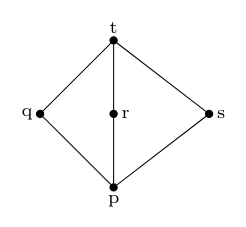
For any , not necessarily distinct , and are join and meet of , respectively. Let be the set of all ordered triplets of the elements of . Let be the probability that an element chosen equiprobably satisfies . Then
View worked solution
Answer: D
To find the probability , we analyze the number of triplets that satisfy the distributive identity:
Since is a finite lattice with elements, it must have a unique least element (bottom) denoted by and a unique greatest element (top) denoted by . Let us count the satisfying triplets:
- Case 1:
The identity becomes , which is always true. Since and can be any of the elements, this gives valid triplets. - Case 2:
The identity becomes , which is always true. This gives another valid triplets.
Since , these two cases are completely disjoint. Thus, there are at least satisfying triplets out of a total of possible triplets.
This gives the lower bound for the probability:
Since the Hasse diagram represents a non-distributive lattice (either or ), the distributive law does not hold universally, meaning . Therefore, we have:
Free practice · Your answers on this page are not saved.