



The following is the Hasse diagram of the poset
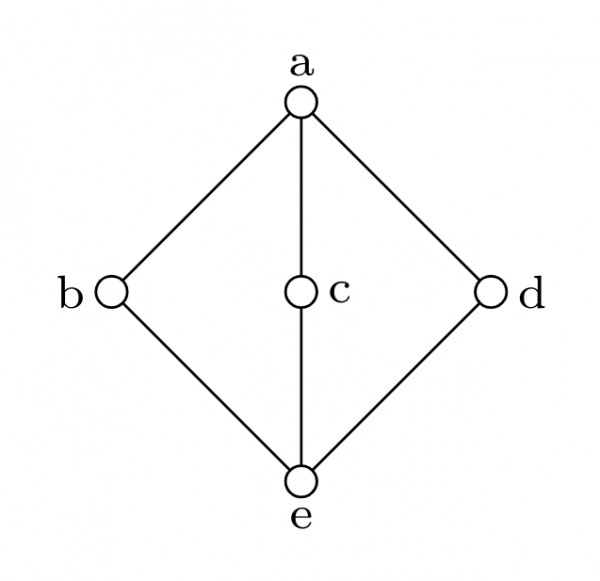
The poset is :
View worked solution
Answer: B
The given Hasse diagram represents the classic pentagon lattice, often denoted as . It consists of the elements with the following relations:
- is the least element (bottom).
- is the greatest element (top).
- One path goes from .
- Another path goes from .
1. Checking if the poset is a Lattice
A poset is a lattice if and only if every pair of elements has a unique least upper bound (LUB or join, ) and a unique greatest lower bound (GLB or meet, ).
- For comparable elements, the LUB and GLB always exist (e.g., and ).
- For incomparable elements and :
- For incomparable elements and :
Since every pair has a unique LUB and GLB, the poset is a lattice.
2. Checking if the lattice is Distributive
A lattice is distributive if it satisfies the distributive law for all elements :
Let us test this with , , and :
- Left-Hand Side (LHS):
- Right-Hand Side (RHS):
Since (), the distributive law does not hold. Thus, the lattice is not distributive.
Therefore, the poset is a lattice but not a distributive lattice.
Free practice · Your answers on this page are not saved.