



Consider the sequential circuit shown in the figure, where both flip-flops used are positive edge-triggered flip-flops.
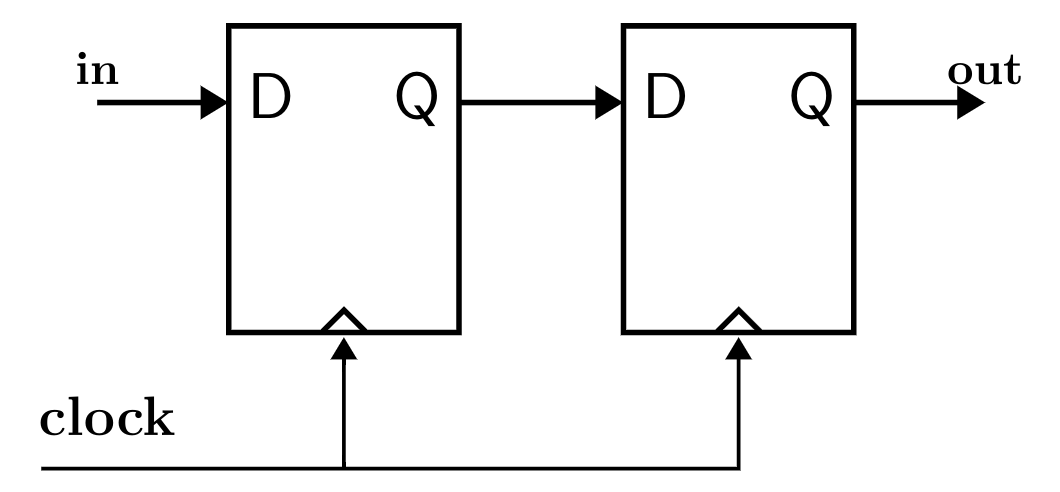
The number of states in the state transition diagram of this circuit that have a transition back to the same state on some value of "in" is ____
View worked solution
Answer: 2
Let the state of the sequential circuit be represented by , where and are the outputs of the first and second D flip-flops respectively.
From the circuit diagram, the input equations to the flip-flops are:
Since the next state of a D flip-flop is equal to its input (), the next-state equations are:
For a state to transition back to itself, we require and for some input value :
- First Condition: This restricts the candidate states to those where .
- Second Condition: Substituting gives:
Thus, for any state with , we can choose to transition back to the same state:
- State transitions to itself when .
- State transitions to itself when .
For states with , we get , making a self-transition impossible.
Hence, there are exactly 2 such states.
Free practice · Your answers on this page are not saved.