Answer: B
To find the number of states in the minimum state automaton, we can use the state minimization algorithm (partition refinement method).
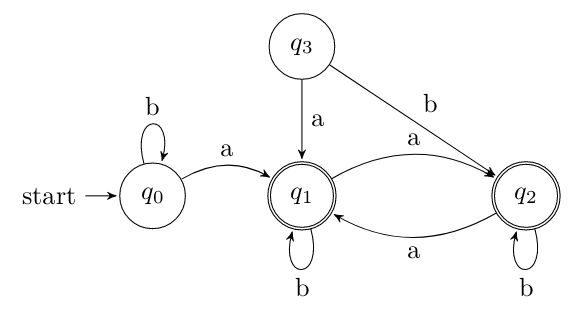
Let the states of the given DFA be q0,q1,q2,q3, where q0 is the start state, and the final states are F={q0,q2}. The transition rules from the given diagram are:
- δ(q0,a)=q1, δ(q0,b)=q2
- δ(q1,a)=q2, δ(q1,b)=q3
- δ(q2,a)=q3, δ(q2,b)=q0
- δ(q3,a)=q0, δ(q3,b)=q1
Step 1: 0-equivalence Partition (P0)
Divide the states into final and non-final states:
P0={{q0,q2},{q1,q3}}
Step 2: 1-equivalence Partition (P1)
We check if the states in each group behave identically on all inputs:
- For {q0,q2}:
On input a: δ(q0,a)=q1 and δ(q2,a)=q3. Both q1,q3 belong to the same group {q1,q3}.
On input b: δ(q0,b)=q2 and δ(q2,b)=q0. Both q2,q0 belong to the same group {q0,q2}.
Thus, q0≡q2. - For {q1,q3}:
On input a: δ(q1,a)=q2 and δ(q3,a)=q0. Both q2,q0 belong to the same group {q0,q2}.
On input b: δ(q1,b)=q3 and δ(q3,b)=q1. Both q3,q1 belong to the same group {q1,q3}.
Thus, q1≡q3.
Since the partition does not split further, P1=P0={{q0,q2},{q1,q3}}. The minimum state automaton has exactly 2 states.