



Consider the following two finite automata and .
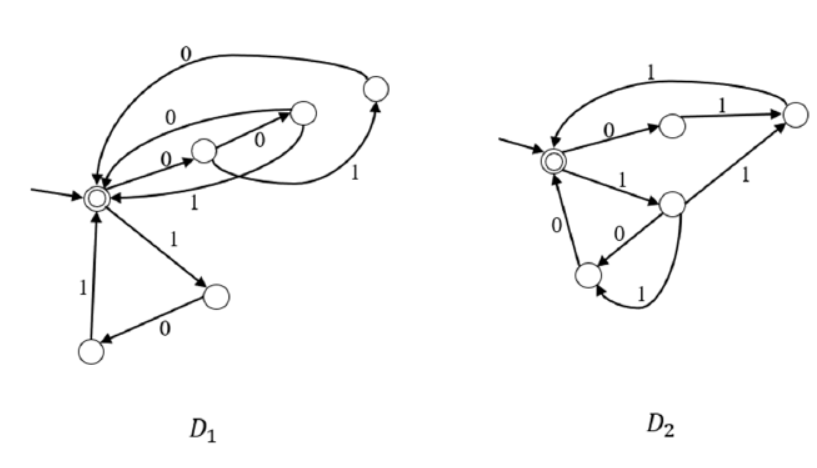
Which of the following statements is/are true?
View worked solution
Answer: C;D
Based on the transition diagrams for and :
- accepts the empty string and all binary strings of length divisible by that start with the symbol . That is, .
- accepts the empty string and all binary strings of length divisible by that start with the symbol . That is, .
Let's evaluate the given options:
- Option A & B: Since but , and but , the languages are not equal, nor is one a proper subset of the other. Thus, A and B are false.
- Option C: Any non-empty string in starts with , while any non-empty string in starts with . The only common string between them is the empty string . Thus, , which is true.
- Option D: The union contains and all strings of length () starting with either or . This is exactly the set of all binary strings whose length is a multiple of . Applying the Kleene star, also consists of all strings in whose length is divisible by . Thus, D is true.
Free practice · Your answers on this page are not saved.