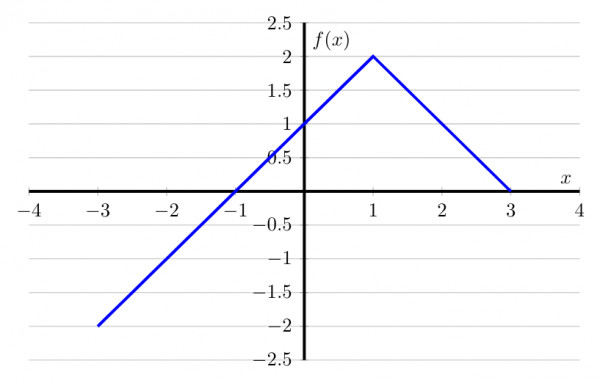
Answer: C
To find the correct function represented by the graph, we can analyze the properties of absolute value functions of the form f(x)=a±∣x−h∣:
- The graph of y=−∣x−h∣ is an inverted V-shape (pointing upwards) with its vertex (peak) at (h,0).
- Adding a constant a shifts the vertex vertically to (h,a), giving the function f(x)=a−∣x−h∣.
Looking at the options, we can test the coordinates of the peak and the intercepts:
- Vertex (Peak): The graph has its peak at the point (1,2). This suggests a function of the form f(x)=2−∣x−1∣.
- x-intercepts: The graph crosses the x-axis at x=−1 and x=3.
Let us verify these points using the function in Option C, f(x)=2−∣x−1∣:
- At x=1:
f(1)=2−∣1−1∣=2(Matches the peak at (1,2))
- At x=3:
f(3)=2−∣3−1∣=2−2=0(Matches the intercept at (3,0))
- At x=−1:
f(−1)=2−∣−1−1∣=2−2=0(Matches the intercept at (−1,0))
Thus, the function represented by the graph is indeed f(x)=2−∣x−1∣.