



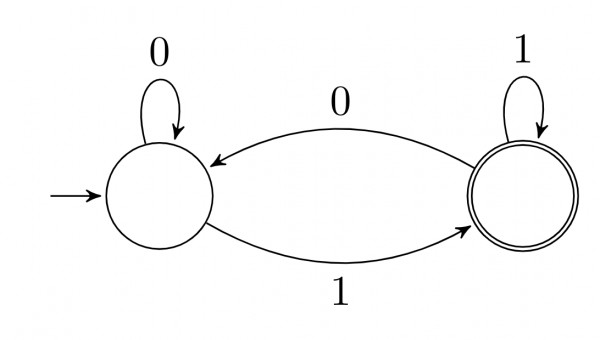
Which of the regular expressions given below represent the following DFA?
View worked solution
Answer: B
The given DFA accepts the language of all binary strings ending with . This language is directly represented by the regular expression III: .
Let us analyze the equivalence of the other expressions:
- Expression I:
- Every string generated by this expression must end in because the initial part ends in , and any string chosen from the Kleene star also ends in .
- It can generate any string ending in . For example:
- Thus, Expression I is equivalent to .
- Expression II:
- Consider the string , which ends in and must be accepted.
- The first term cannot generate because no can appear after a .
- The second term cannot generate because it must start with .
- Since is not represented, Expression II is incorrect.
Hence, only I and III represent the DFA.
Free practice · Your answers on this page are not saved.