



Consider the DFA given below.
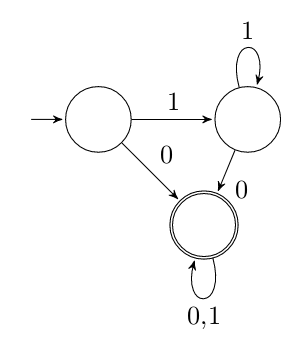
Which of the following are FALSE?
- Complement of is context-free.
- For the language accepted by is the minimal DFA.
- accepts all strings over of length at least .
View worked solution
Answer: D
Let us analyze each statement based on the language of the DFA :
- Statement 1 is TRUE: Since is a DFA, the language is regular. Regular languages are closed under complementation, and every regular language is also context-free.
- Statement 2 is TRUE: The regular expression simplifies to , which represents the set of all strings over containing at least one . The given DFA accepts exactly this language.
- Statement 3 is FALSE: The minimal DFA for the language "at least one " requires only states (a start state that loops on and goes to an accepting state on , which then loops on both and ). The given DFA has states, meaning it is not minimal.
- Statement 4 is FALSE: The string has a length of but contains no , so it is not accepted by . Thus, does not accept all strings of length at least .
Since statements 3 and 4 are FALSE, the correct option is D.
Free practice · Your answers on this page are not saved.