



In the array shown below, each cell of the first three rows has either a cross or a number.
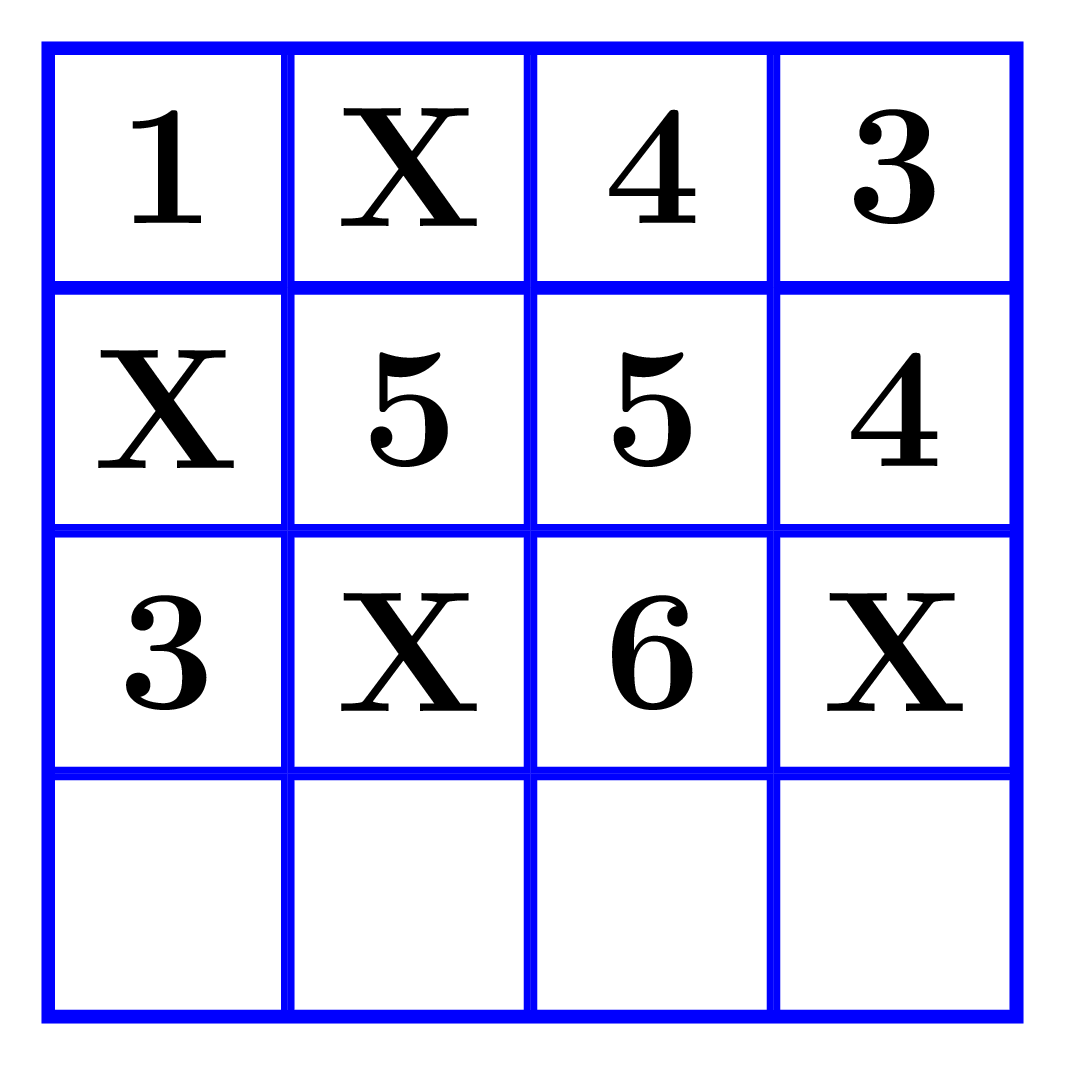
The number in a cell represents the count of the immediate neighboring cells (left, right, top, bottom, diagonals) NOT having a cross ( ). Given that the last row has no crosses , the sum of the four numbers to be filled in the last row is
View worked solution
Answer: A
Let the four cells in the last (fourth) row be denoted as and from left to right. Since the last row contains no crosses (), all these cells contain numbers.
The third row of the grid is given as:
- (number)
- (number)
We determine the value of each cell in the fourth row by counting its immediate neighboring cells that do not contain a cross ():
- For (at ): Its neighbors are (), (number), and (number). Thus, .
- For (at ): Its neighbors are (), (number), (), (number), and (number). Thus, .
- For (at ): Its neighbors are (number), (), (number), (number), and (number). Thus, .
- For (at ): Its neighbors are (), (number), and (number). Thus, .
Summing these four values:
Free practice · Your answers on this page are not saved.