



Consider a network with three routers shown in the figure below. All the links have cost of unity.
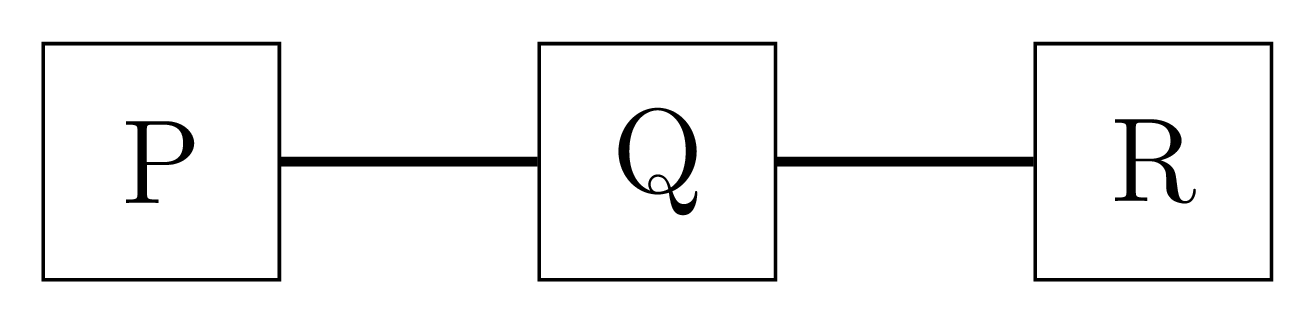
The routers exchange distance vector routing information and have converged on the routing tables, after which the link fails. Assume that and send out routing updates at random times, each at the same average rate. The probability of a routing loop formation (rounded off to one decimal place) between and leading to count-to-infinity problem, is _______________.
View worked solution
Answer: 0.5
Initially, the network is connected as with unit link costs. The routing paths to destination before the link failure are:
- reaches directly with a cost of (next hop: ).
- reaches via with a cost of (next hop: ).
When the link fails, immediately detects the failure and updates its distance to to .
Since and send routing updates independently at random times with the same average rate, the next update event is equally likely to be initiated by either router (each with probability ):
- Case 1: sends its update to first (Probability = )
Before can inform about the failure, sends its periodic update advertising a path to with cost . receives this and, having no other path, updates its route to via with cost . This creates a routing loop (), leading to the count-to-infinity problem. - Case 2: sends its update to first (Probability = )
informs that is unreachable (cost ). updates its routing table accordingly, and no loop is formed.
Thus, the probability of a routing loop formation is .
Free practice · Your answers on this page are not saved.