



In a pushdown automaton , a transition of the form,
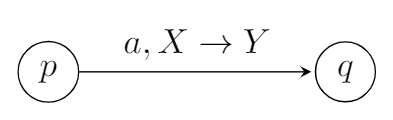
where , , and , represents Consider the following pushdown automaton over the input alphabet and stack alphabet .
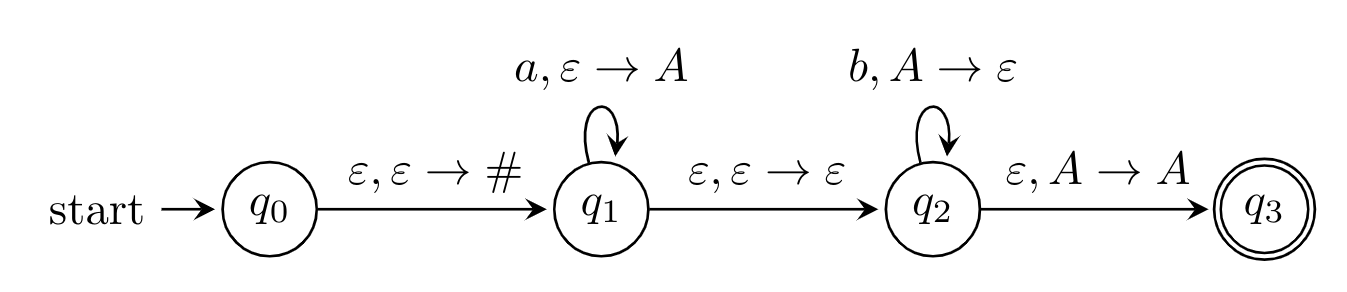
The number of strings of length accepted by the above pushdown automaton is ___________
View worked solution
Answer: 50 : 50
By analyzing the transitions of the given pushdown automaton (PDA), we can determine the language it accepts:
- State (Push Phase): For every symbol read, an is pushed onto the stack. Thus, reading (where ) results in 's on the stack above the initial symbol .
- State (Pop Phase): The transition from to occurs on the first , popping one . Subsequent 's are read in , each popping one . If 's are read in total (), then 's are popped.
- State (Acceptance Phase): The PDA transitions to the final state on input if:
- The stack has only left (i.e., ), via transition .
- The stack still has 's left (i.e., ), via transition .
Thus, the language accepted by the PDA is:
We need to find the number of strings in of length :
Substituting into the inequality:
Since , the possible integer values for are:
Each value of uniquely determines . Therefore, there are exactly 50 such strings.
Free practice · Your answers on this page are not saved.