Skip to content
Official PYQ · 2021

GATE CS 2021 Set 1 Q54 — Conditional Probability and Bayes Theorem

Explain with AI

A sender (S)(\textsf{S}) transmits a signal, which can be one of the two kinds: HH and LL with probabilities 0.10.1 and 0.90.9 respectively, to a receiver (R)(\textsf{R}).

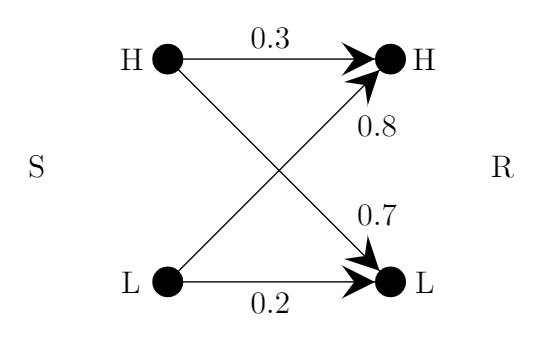
In the graph below, the weight of edge (u,v)(u,v) is the probability of receiving vv when uu is transmitted, where u,v∈{H,L}u,v \in \{H,L\}. For example, the probability that the received signal is LL given the transmitted signal was HH, is 0.70.7.

If the received signal is H,H, the probability that the transmitted signal was HH (rounded to 22 decimal places) is __________.

View worked solution

Answer: 0.04 : 0.04

We are given the prior probabilities of the transmitted signals:

  • P(Htx)=0.1P(H_{\text{tx}}) = 0.1
  • P(Ltx)=0.9P(L_{\text{tx}}) = 0.9

From the transition graph, the conditional probabilities of receiving a signal given the transmitted signal are:

  • P(Lrx∣Htx)=0.7  ⟹  P(Hrx∣Htx)=1−0.7=0.3P(L_{\text{rx}} \mid H_{\text{tx}}) = 0.7 \implies P(H_{\text{rx}} \mid H_{\text{tx}}) = 1 - 0.7 = 0.3
  • P(Hrx∣Ltx)=0.8  ⟹  P(Lrx∣Ltx)=1−0.8=0.2P(H_{\text{rx}} \mid L_{\text{tx}}) = 0.8 \implies P(L_{\text{rx}} \mid L_{\text{tx}}) = 1 - 0.8 = 0.2

We need to find the posterior probability that the transmitted signal was HH given that the received signal is HH, i.e., P(Htx∣Hrx)P(H_{\text{tx}} \mid H_{\text{rx}}). Applying Bayes' theorem:

P(Htx∣Hrx)=P(Hrx∣Htx)⋅P(Htx)P(Hrx∣Htx)⋅P(Htx)+P(Hrx∣Ltx)⋅P(Ltx)P(H_{\text{tx}} \mid H_{\text{rx}}) = \frac{P(H_{\text{rx}} \mid H_{\text{tx}}) \cdot P(H_{\text{tx}})}{P(H_{\text{rx}} \mid H_{\text{tx}}) \cdot P(H_{\text{tx}}) + P(H_{\text{rx}} \mid L_{\text{tx}}) \cdot P(L_{\text{tx}})}

Substituting the values into the formula:

P(Htx∣Hrx)=0.3×0.1(0.3×0.1)+(0.8×0.9)=0.030.03+0.72=0.030.75=0.04P(H_{\text{tx}} \mid H_{\text{rx}}) = \frac{0.3 \times 0.1}{(0.3 \times 0.1) + (0.8 \times 0.9)} = \frac{0.03}{0.03 + 0.72} = \frac{0.03}{0.75} = 0.04

Free practice · Your answers on this page are not saved.

Published
Report a correction
Keep exploringMore Conditional Probability and Bayes Theorem questions