



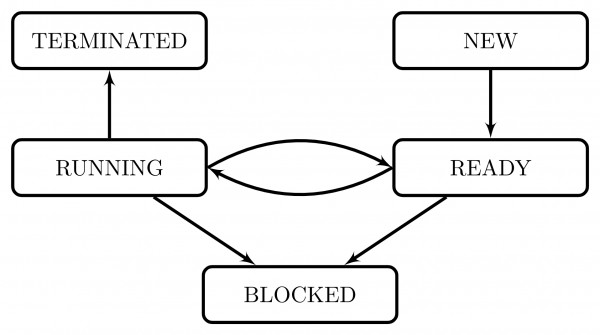
The process state transition diagram in the below figure is representative of
View worked solution
Answer: B
The standard process state transition diagram contains three primary states: Ready, Running, and Blocked (or Waiting).
The key transition that distinguishes a preemptive scheduler from a non-preemptive one is the direct transition from the Running state back to the Ready state:
- Running Ready: This transition occurs when a running process is forcibly interrupted by the operating system (e.g., due to a time-slice expiration/timeout or the arrival of a higher-priority process) and placed back into the ready queue. This is the defining characteristic of preemption.
Let's analyze the other options:
- In a non-preemptive scheduler, a process continues to run until it either terminates or voluntarily yields the CPU (e.g., by making an I/O request, moving to the Blocked state). Thus, the direct transition from Running to Ready is absent.
- A batch operating system or a uni-programmed system typically executes jobs sequentially without preempting them mid-execution for other processes.
Therefore, the state transition diagram represents an operating system with a preemptive scheduler.
Free practice · Your answers on this page are not saved.