



Consider a network with routers to connected with links having weights as shown in the following diagram.
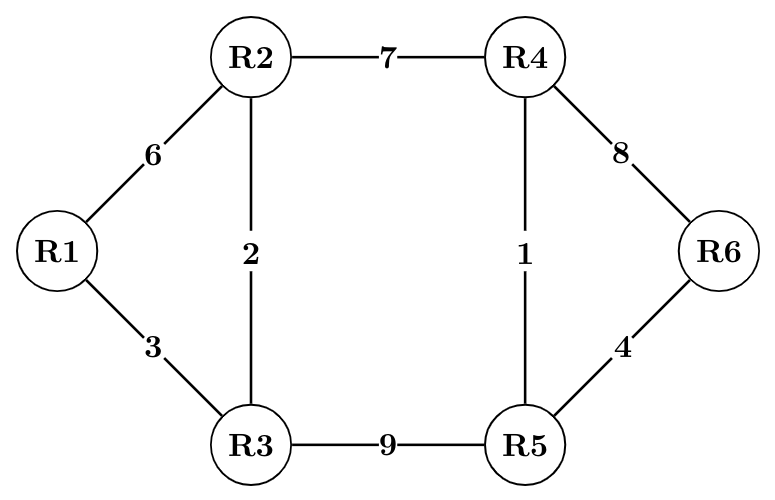
All the routers use the distance vector based routing algorithm to update their routing tables. Each router starts with its routing table initialized to contain an entry for each neighbor with the weight of the respective connecting link. After all the routing tables stabilize, how many links in the network will never be used for carrying any data?
View worked solution
Answer: C
In a distance vector routing network, once the routing tables stabilize, data is always routed along the shortest paths between nodes. A link is never used if there exists an alternative path between its endpoints that has a strictly lower cost than the direct link itself.
The network consists of the following links and weights:
Let's analyze the direct links to see if they are bypassed by shorter paths:
- Link (weight 6): The path has a cost of . Since , the direct link is never used.
- Link (weight 5): The path has a cost of . Since , the direct link is never used.
For all other links, the direct link is the shortest path between its endpoints, so they will be used. Thus, exactly 2 links will never be used for carrying any data.
Free practice · Your answers on this page are not saved.