



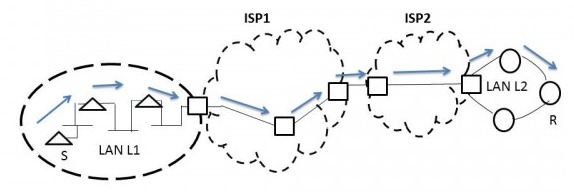
In the diagram shown below, is an Ethernet LAN and is a Token-Ring LAN. An packet originates from sender and traverses to , as shown. The links within each and across the two s, are all point-to-point optical links. The initial value of the field is . The maximum possible value of the field when receives the datagram is _______.
View worked solution
Answer: 26
To find the maximum possible value of the Time-to-Live (TTL) field when the receiver receives the datagram, we need to understand how TTL is processed across different network layers:
- Layer 3 (Network Layer) Processing: The TTL field is part of the IP header. Every router (Layer 3 device) that forwards the IP packet decrements the TTL value by at least .
- Layer 2 (Data Link Layer) Processing: LAN devices such as switches, bridges, or hubs operating at the Data Link Layer (within Ethernet and Token-Ring ) do not modify or decrement the TTL field.
By tracing the path from sender to receiver in the given network diagram, the packet traverses exactly routers:
- Router 1: Connects Ethernet LAN to ISP 1.
- Router 2 & Router 3: Internal/boundary routers within ISP 1.
- Router 4 & Router 5: Internal/boundary routers within ISP 2.
- Router 6: Connects ISP 2 to Token-Ring LAN .
Since each of these routers decrements the TTL by :
Thus, the maximum possible value of the TTL field when receives the datagram is 26.
Free practice · Your answers on this page are not saved.